You

Stay calm πŸ™ and kick butt βš”️

Here are a few tips that helped me get through times when I felt lost or hopeless. This is my practical, step-by-step guide, hard-earned and tested in real life.

Setting goals

Decide what you want. Pick a small goal for now — anything useful. Take the pressure off. Just pick something to work on that you can do.

Think short-term and what’s in your control. What can do you today, tomorrow, this week, this month? You can act most effectively in this timeframe.

Narrow your focus: Do one (main) thing at a time. You can’t do everything all at once. Once you finish a major goal, you can move on to the next with even more focus, having the first thing done.

Working towards goals

πŸ‘‰ It takes practice.

Visualize the outcome you want. Close your eyes, breath, and picture in vivid detail what you want to happen. This may sound silly, but it can help motivate you and sharpen your focus.

Work towards the outcome you want in small steps every day. Keep your current daily goals modest; keeping a backlog of stuff to do later is helpful.

πŸ‘‰ Doing Great Things is Boring πŸ€·πŸ»β€β™‚️.

Place your happiness in the progress towards the results, not in the result itself. Steady work in itself will make you feel better.

πŸ‘‰ β€œThe foolish man seeks happiness in the distance; the wise grows it under his feet.”

Yes, work towards an outcome, but don’t get attached to it; you can’t control everything. Focus on what you can do right now and take pride in your effort, however it may turn out.

Keep your ego in check. Do things because they go with your values and goals and not to look good or to avoid judgement.

Your happiness depends only on you, not on external people, places, or things.

πŸ‘‰ The Secrets to Happiness (Distilled)

Taking care of yourself

Enjoy nourishing foods any time you want: water, tea, bone broth, fruit, avocado, nuts, yogurt…

Try some calming sounds. Listen to some ambient music, nature sounds, movie soundtracks, whatever works. You can find these in your music app or even YouTube.

πŸ‘‰ The Best Music for Working

Freshen up your environment. Get outside for some sunlight and fresh air. Open a window. Light a scented candle or incense. Clean and tidy your home.

Move. Walk, stretch, exercise every day. Find an exercise (or two) that works for you. 🧘🏻

Taming your mind

It takes practice.☝️

πŸ‘‰ Super Summary: Think Like a Monk

Ask yourself – is this useful? If you find yourself having unhelpful, repetitive thoughts, then nip them in the bud. These are usually about a past or future that you can’t control and can’t solve by thinking.

Take a few deep breaths, then work on calming yourself.

Focus your mind on a gameWordle, a crossword puzzle, or a chill app like isowords, Townscaper, paper.io, or MiniMetro.

Work through your thoughts and feelings with journaling. Don’t hold back. Get it all out – the good, the bad, and the ugly. Or just write a haiku about your day to make it more fun. πŸ€·πŸ»β€β™‚οΈ

Meditate: Clear and observe your mind non-judgmentally. Scan your body, focus on breathing, visualize success, give gratitude, find empathy for others.

Feed your heart, not your fears

Fear makes you do stupid things and must be conquered.

πŸ‘‰ β€œFear is the mind-killer.β€β€œMove, but don’t move the way fear makes you move.”.

Above all, keep faith in yourself. ✌️

πŸ‘‰ β€œMay your choices reflect your hopes, not your fears”

Books · creativity · Practical

Super Summary: Deep Work

Next up in my super summary series: Deep Work: Rules for Focused Success in a Distracted World by Cal Newport.

On this blog, a super summary is basically a β€œsummary of a summary” of a book (with a few additions of my own). It gives you the basic idea of a book to see if you want to read the real thing. Most of the content comes from Lucid visual book summary series.

πŸ‘‰This book gives you official permission to set your chat app to do-not-disturb or enable Focus mode on your iPhone.

Deep vs. shallow work

Shallow work is work that’s done in small pieces, doesn’t require your full attention, and keeps you busy. It is often necessary, but it does not lead to great achievements.

Deep work means complex thinking in a state of distraction-free concentration or flow. Your brain can do amazing things in this state of focus.

Many great thinkers in history went to incredible lengths to isolate themselves from distractions while they worked. Studies show that many of people’s happiest moments come when they are stretched to their mental limits and lose themselves in this state.

This intense focus allows you to master difficult skills and produce at an elite level. It’s a career builder.

Making time for deep work

Switching frequently between tasks leaves “attention residue” and makes it difficult to focus on a new task after switching focus, especially if you leave the previous ask unfinished.

To allow yourself to get the most out of deep work, schedule your time in blocks of deep and shallow work with one of the following strategies.

πŸ‘‰I’ve found that I can only be productive at deep work for about 90 minutes at a time. Then I need a mental break. 🀯

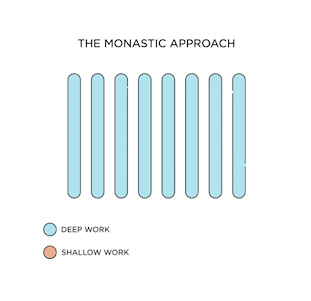
Monastic

On one end, monastic deep workers go to great lengths to make time for deep work. They eliminate social media and use email sparingly to achieve their goals.

πŸ‘‰This seems pretty extreme unless you aim to be Henry David Thoreau at Walden Pond or Bon Iver at his cabin in Wisconsin. πŸ€·πŸ»β€β™‚οΈ

Bimodal

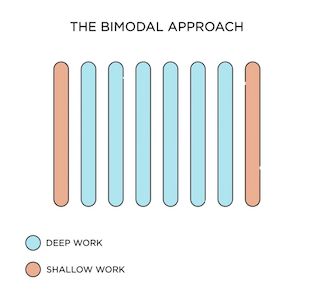
Bimodal deep workers plan their day in larger blocks to make time for both the shallow and deep work they need to do.

This strategy can mean bookending a solid day of deep work email and busy work at the beginning and end of the day.

 Rhythmic

Rhythmic deep workers break their time down into smaller chunks to fit their broken-up schedule.

πŸ‘‰This is how I work because, you know, meetings. πŸ€·πŸ»β€β™‚οΈ

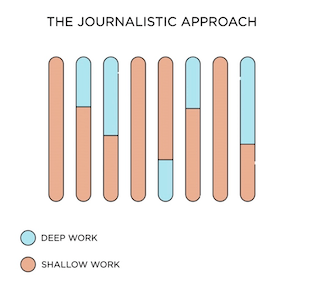
Journalistic

For those with even less predictable days, journalistic scheduling capitalizes on spare moments that come up throughout the day, even if it’s just 30 minutes.

These people keep fighting for deep work time as their day evolves. πŸƒπŸ»β€β™€οΈ

πŸ‘‰ For some additional ideas, check out Wired article How to Use Block Scheduling to Revamp Your Workflow.

Software Dev

“What you can see here is that I was learning…”

I love this post from swiftjectivec.com.

πŸ‘‰ Things I Made That Sucked

Not only does he detail the interesting stories of some old apps he made, but also the valuable lessons learned from each app that he shipped.

Highlights

Aim first, then shoot. “Ask yourself why you’re doing what you’re doing and channel your excitement into less action and more thinking before you fire away.”

Pace yourself and don’t complicate. “Take time to learn about design and holy moses don’t toss in an open source project just because it’s shiny.”

There is no overnight success. “Always remember that character is carved out rather than instantly created. Each of these misses can eventually add up to a win.”

My own lessons

Applying the same thought process to my own old apps, here is what I come up with…

Where in the World is Santa Claus?

Ignorance is bliss. I genuinely thought it would be easy to make an augmented reality Santa tracker as my very first iPhone app. Who cared that built-in AR support on the iPhone was years in the future?

I understood that I’d have to learn Objective-C and Xcode as I went. However, I did not appreciate how much there was to learn about location APIs, motion APIs, audio APIs, audio editing, 2D animations, CoreData, the State Pattern, linear algebra 🀯, the terrors (at the time) of shipping in the App Store, plus legal/privacy matters. Also why not translate the app into six languages, starting with Spanish?

And all just to see Santa blink on your screen when you pointed your iPhone north. πŸ˜†

My blissful ignorance allowed me to jump in fearlessly and forced me to conquer a mountain of challenges as I went (or quit).

This app only ever sold a few hundred copies but was a goldmine of experience and made me a mobile developer.

Bedtime Balloons

Simpler is better. App #2 was more useful and less technically challenging than the AR Santa app. Bedtime Balloons let me get into some fun art and more interesting animations. Plus this app actually made a difference in at least a few people’s lives.

Third-party frameworks can kill your app. At the time, there was no standard 2D animation engine for iOS. SpriteKit was not a thing yet. πŸ€·πŸ»β€β™‚οΈ So just like the Santa app, I built the animations around the very nice Cocos2d engine, which would eventually morph and evolve and… break my app. πŸ€¦πŸ»β€β™‚οΈ Yeah, I could have rewritten my app, but again only selling a few hundred copies, I chose to avoid all the sweat and tears and just move on.

Continuous Math Cards

Be practical. I never expected to sell many copies of my barebones but highly configurable math flashcards app for kids.

Written quickly in the new (at the time) Swift language, the app was alright. πŸ€·πŸ»β€β™‚οΈ But it worked for me professionally. My next step would be a full-time day job as an app developer, which had long been my dream.