Software Dev

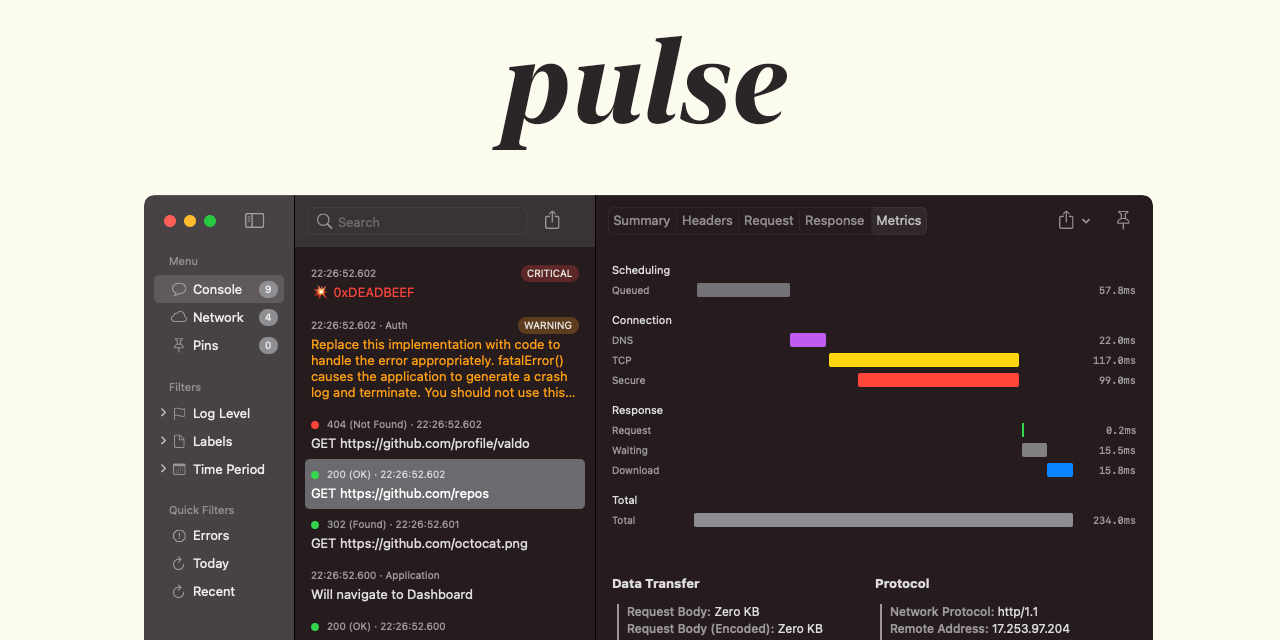
Pulse: Network Inspector

If you want to debug your network traffic on iOS, Pulse looks like a great alternative to WiresharkProxyman, and Charles Proxy.

Pulse takes a different approach, embedding into your app rather than sniffing the network, which can be pretty invasive. (Proxyman “basically performs a MITM attack to see your encrypted traffic.” πŸ€”)

πŸ‘‰ Pulse: Network Inspector

What I wished iOS had is a simple analog of Safari Web Inspector. So I built just that.

Via iOS Dev Weekly.

Pulse Logo
Software Dev

Mobile Native Foundation: Developing Large-Scale Apps

Writing apps for a large organization has its own unique challenges.

Large teams require that you collaborate in complex ways while keeping quality and delivery speed high. It’s not straightforward, and it makes the days of knocking out an app on your own look fun and easy, if somewhat solitary.

@MobileNativeFoundation

It’s not just about “data structures and algorithms” or any of that Computer Science 101 stuff at this level.

The Mobile Native Foundation is a new organization that focuses on large-scale app development issues for iOS and Android.

It’s mostly just discussion groups right now, but they have contributions from people at large companies with apps you know and respect such as Lyft and Spotify.

The discussions cover relevant topics ranging from organizational (such as Encouraging and enforcing testing), to design (Building Modern UI), to technical (Splitting an app into modules).

πŸ‘‰ This site also reminds me of a book on large-scale app development that I’m currently working through: Building Mobile Apps at Scale.

Via iOS Dev Weekly.

Software Dev

Introducing Swift Collections

Swift Collections is out with some new collection-oriented extensions on the Swift language as a companion to Swift Algorithms and Swift Numerics.

πŸ‘‰ Introducing Swift Collections | github

Swift Collections gives you hybrid collection types like Deque, which is an array with “efficient insertions and removals at both ends”, OrderedSet, which is a “powerful hybrid of an Array and a Set”, and OrderedDictionary (like the actual dictionary).

And of course, they’re efficient. Now go forth and collect in new ways!

Software Dev

The Singleton Pattern – When There Can Only Be One β˜οΈ

Like so many smart and courageous people, the Singleton design pattern is often misunderstood.

Whether it is attacked as an anti-pattern, maligned as untestable, or misused as a global convenience, singletons take a lot of πŸ’© for just being what they are: a way to enforce that there is only ever one of something. I think they should call this pattern “The One”.

A real life example of a singleton is The President of the United States. We only ever have one president at a time. That’s a key part of the concept. It’s not just a convenience.

In software terms, singletons make sense in many cases such as the one and only instance of the current app running on the current iPhone.

With all this in mind, this quick post provides some nice context about singletons (aka the President) versus just a shared instance (hey, let’s all share this one bike) in Swift.

πŸ‘‰ What’s the difference between a singleton and a shared instance in Swift?

Thanks to iOS Dev Weekly for calling out the ongoing confusion on this topic. πŸ™

Software Dev

Getting Started with Instruments

Has there ever been a more powerful, but under-utilised tool than Instruments?

Instruments is a tool included with Xcode that helps you analyze, profile, and debug your live iOS app. Solve memory leaks. Visualize memory. Monitor disk, network, memory, and battery usage. You can even find zombies. πŸ§Ÿβ€β™‚οΈ

It lets you do incredible things but is also overwhelming to new developers, in which case this Ray Wenderlich tutorial can come in pretty handy.

πŸ‘‰ Getting Started with Instruments

There’s also an Apple WWDC presentation with this same name. πŸ˜†

Visual Memory Debugger

Via iOS Dev Weekly.