
Next up in my super summary series: Deep Work: Rules for Focused Success in a Distracted World by Cal Newport.
On this blog, a super summary is basically a “summary of a summary” of a book (with a few additions of my own). It gives you the basic idea of a book to see if you want to read the real thing. Most of the content comes from Lucid visual book summary series.
👉This book gives you official permission to set your chat app to do-not-disturb or enable Focus mode on your iPhone.
Deep vs. shallow work
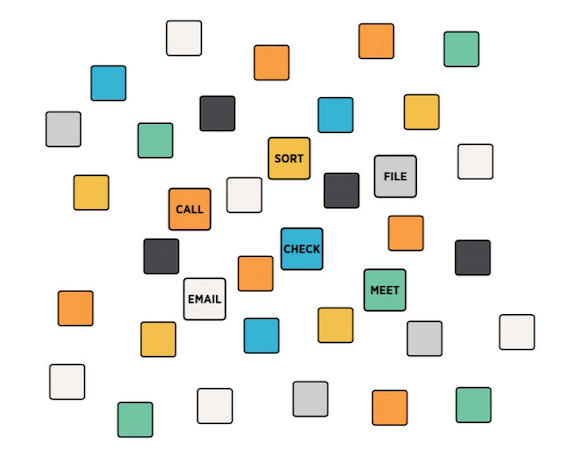
Shallow work is work that’s done in small pieces, doesn’t require your full attention, and keeps you busy. It is often necessary, but it does not lead to great achievements.
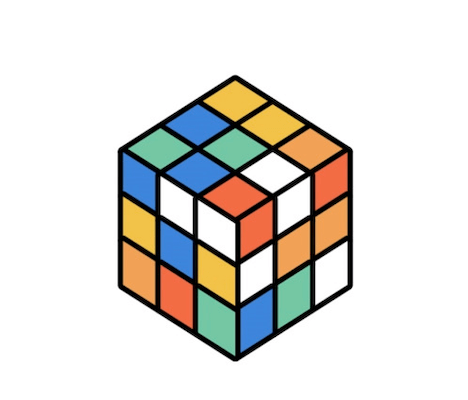
Deep work means complex thinking in a state of distraction-free concentration or flow. Your brain can do amazing things in this state of focus.
Many great thinkers in history went to incredible lengths to isolate themselves from distractions while they worked. Studies show that many of people’s happiest moments come when they are stretched to their mental limits and lose themselves in this state.
This intense focus allows you to master difficult skills and produce at an elite level. It’s a career builder.
Making time for deep work
Switching frequently between tasks leaves “attention residue” and makes it difficult to focus on a new task after switching focus, especially if you leave the previous ask unfinished.
To allow yourself to get the most out of deep work, schedule your time in blocks of deep and shallow work with one of the following strategies.
👉I’ve found that I can only be productive at deep work for about 90 minutes at a time. Then I need a mental break. 🤯
Monastic
On one end, monastic deep workers go to great lengths to make time for deep work. They eliminate social media and use email sparingly to achieve their goals.
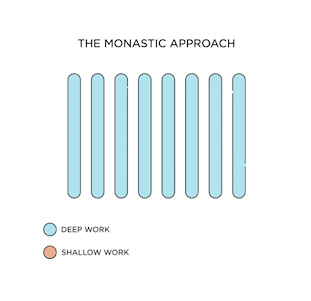
👉This seems pretty extreme unless you aim to be Henry David Thoreau at Walden Pond or Bon Iver at his cabin in Wisconsin. 🤷🏻♂️
Bimodal
Bimodal deep workers plan their day in larger blocks to make time for both the shallow and deep work they need to do.
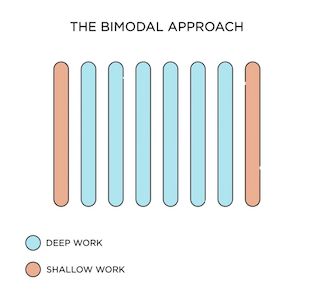
This strategy can mean bookending a solid day of deep work email and busy work at the beginning and end of the day.
Rhythmic
Rhythmic deep workers break their time down into smaller chunks to fit their broken-up schedule.

👉This is how I work because, you know, meetings. 🤷🏻♂️
Journalistic
For those with even less predictable days, journalistic scheduling capitalizes on spare moments that come up throughout the day, even if it’s just 30 minutes.
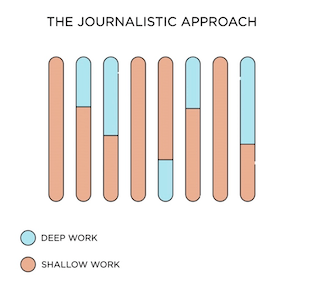
These people keep fighting for deep work time as their day evolves. 🏃🏻♀️
👉 For some additional ideas, check out Wired article How to Use Block Scheduling to Revamp Your Workflow.
 Mental Break Town