Books · Quotes · You

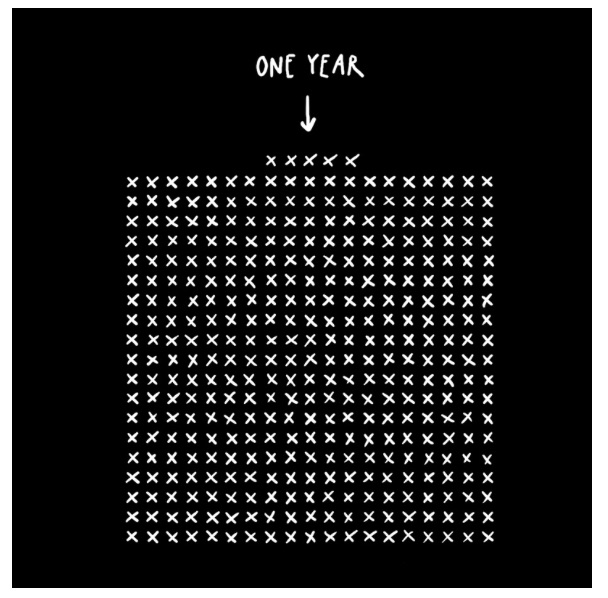
“If you work on something a little bit every day, you end up with something that is massive.”

I like this idea…

If you work on something a little bit every day, you end up with something that is massive.

Kenneth Goldsmith

The book Show Your Work references this quote and really brings it home with an image that illustrates how a good picture can outshine even the best words.

๐Ÿ‘‰ By the way, Show Your Work inspires this blog and will most definitely be getting its own super summary (or series) here (eventually).

The World

How efficient are you at reading this article? ๐Ÿง

Here’s an interesting article from the New York Times on how many companies digitally monitor their employees’ time in some pretty invasive and distrustful ways.

This includes taking screenshots and photos randomly in 10-minute chunks and actually docking pay if you don’t appear productive. So every trip to the bathroom is possible lost pay. ๐Ÿคฆ๐Ÿปโ€โ™‚๏ธ

And hospice workers being paid by productivity points. ๐Ÿ˜ณ “A visit to the dying: as little as one point.”

And social workers being penalized for not typing on their keyboard while actively counseling patients in drug treatment facilities. ๐Ÿคจ

But the brilliance of this article is how they present it.

To let you appreciate how annoying this kind of digital surveillance is, the article tells you as you read it if you’ve been “idle” for too long. It ends with a summary of your reading efficiency stats, which will inevitably make you feel weird. ๐Ÿ˜‚

Also, I wonder how these companies would feel about the The Ship Repairman Story.

Books · creativity · Practical

Super Summary: Deep Work

Next up in my super summary series: Deep Work: Rules for Focused Success in a Distracted World by Cal Newport.

On this blog, a super summary is basically a โ€œsummary of a summaryโ€ of a book (with a few additions of my own). It gives you the basic idea of a book to see if you want to read the real thing. Most of the content comes from Lucid visual book summary series.

๐Ÿ‘‰This book gives you official permission to set your chat app to do-not-disturb or enable Focus mode on your iPhone.

Deep vs. shallow work

Shallow work is work thatโ€™s done in small pieces, doesnโ€™t require your full attention, and keeps you busy. It is often necessary, but it does not lead to great achievements.

Deep work means complex thinking in a state of distraction-free concentration or flow. Your brain can do amazing things in this state of focus.

Many great thinkers in history went to incredible lengths to isolate themselves from distractions while they worked. Studies show that many of people’s happiest moments come when they are stretched to their mental limits and lose themselves in this state.

This intense focus allows you to master difficult skills and produce at an elite level. It’s a career builder.

Making time for deep work

Switching frequently between tasks leaves “attention residue” and makes it difficult to focus on a new task after switching focus, especially if you leave the previous ask unfinished.

To allow yourself to get the most out of deep work, schedule your time in blocks of deep and shallow work with one of the following strategies.

๐Ÿ‘‰I’ve found that I can only be productive at deep work for about 90 minutes at a time. Then I need a mental break. ๐Ÿคฏ

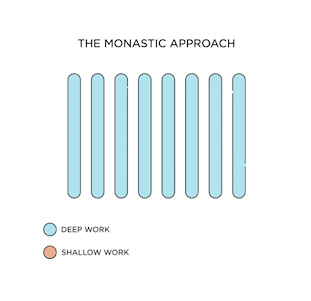
Monastic

On one end, monastic deep workers go to great lengths to make time for deep work. They eliminate social media and use email sparingly to achieve their goals.

๐Ÿ‘‰This seems pretty extreme unless you aim to be Henry David Thoreau at Walden Pond or Bon Iver at his cabin in Wisconsin. ๐Ÿคท๐Ÿปโ€โ™‚๏ธ

Bimodal

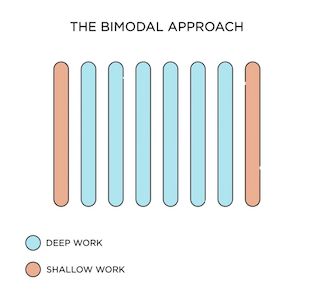
Bimodal deep workers plan their day in larger blocks to make time for both the shallow and deep work they need to do.

This strategy can mean bookending a solid day of deep work email and busy work at the beginning and end of the day.

 Rhythmic

Rhythmic deep workers break their time down into smaller chunks to fit their broken-up schedule.

๐Ÿ‘‰This is how I work because, you know, meetings. ๐Ÿคท๐Ÿปโ€โ™‚๏ธ

Journalistic

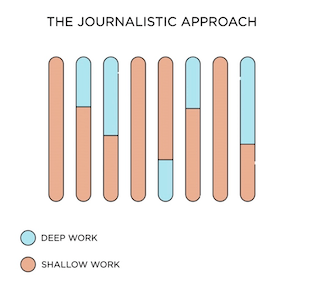
For those with even less predictable days, journalistic scheduling capitalizes on spare moments that come up throughout the day, even if it’s just 30 minutes.

These people keep fighting for deep work time as their day evolves. ๐Ÿƒ๐Ÿปโ€โ™€๏ธ

๐Ÿ‘‰ For some additional ideas, check out Wired article How to Use Block Scheduling to Revamp Your Workflow.
Quotes · You

“If all you have is a hammer, everything looks like a nail.”

This Abraham Maslow fellow doesn’t just have a pyramid, he also has a hammer. Here is the popular phrasing of Maslow’s Hammer.

If all you have is a hammer, everything looks like a nail.

Maybe Maslow

I love this saying. People often “hammer away” at something the wrong way, wasting time and failing to learn a new skill.

It’s easy to make this mistake.

As a software engineer, I’ve seen this 1000 times. “Well, we have a bunch of web servers, and we need a mobile app, so… let’s make our mobile app using web tech!” At first, it seems to make sense. But you end up with a crappy app, lots of extra work, and maybe even some unhappy developers who leave because they care about their career too much. They want to use Xcode because that’s a great tool for making apps.

(But beware, Xcode could become your next hammer. ๐Ÿคท๐Ÿปโ€โ™‚๏ธ)

Me

All the “Things” 2020

I’ve been using the Things app to track all my personal to-do’s and projects for a couple of years now. I love this Mac-assed Mac app and use it all the time.

I recently discovered how to get access to the Things database and took the chance to reflect on how Iโ€™m spending my time.

So here are some highlights of all my “Things” in 2020.

Lastly year, I completed 108 personal projects. Each project consists of a number of specific to-do items (tasks). A project can be something small like ๐Ÿ›ณ Renew passport (6 tasks) or big like ๐ŸŽธConvert guest room to a music studio (31 tasks).

I generally include an emoji in my project names because somehow they help motivate me. ๐Ÿคท๐Ÿปโ€โ™‚๏ธ

Some favorite completed projects of 2020 were:

  • ๐Ÿ—ณVote (3 tasks)
  • ๐Ÿคนโ€โ™‚๏ธPlan for best self (7 tasks)
  • ๐Ÿฆ Corona (5 tasks), my most fitting “project” for 2020

I canceled 9 projects, such as:

  • ๐ŸŒถHome gardening
  • ๐Ÿฅ‹Grav Maga
  • ๐Ÿฆƒ Holiday family plans, the most fitting cancellation for 2020

I completed 11 projects to “fix” things, including:

  • ๐ŸFix that gap under my door (3 tasks)
  • ๐ŸฅFix drums (luckily only 2 tasks and zero dollars)
  • โœ๏ธBlog fix up (6 tasks)

Top project in progress:

  • ๐Ÿ“˜Write a book (43 tasks completed, many more to go — and growing)

In 2020, I completed about 7 per day on average. This is useful because it tells me how to pace myself.

I canceled about 1.4 per day. Canceling isnโ€™t a bad thing โ€” itโ€™s just the opposite. Itโ€™s a conscious choice not to do something you thought you needed to do.

Going into the new year, I have 62 projects in progress. Hmm, it already looks like a busy year coming up. ๐Ÿค”


Here is one of the SQLite queries I used for this post. ๐Ÿ‘จ๐Ÿปโ€๐Ÿ’ป

SELECT title, date(creationDate, 'unixepoch') as start, date(stopDate, 'unixepoch') as stop from TMTask
WHERE type = 1
AND status = 3
AND date(creationDate, 'unixepoch') BETWEEN '2020-01-01' AND '2020-12-31'
ORDER BY creationDate