Software Dev

Why asynchronous programming is (was) hard

One of the most difficult things about mobile development is asynchronous programming, which means doing different things at the same time. This is not the normal flowchart-style sequence of traditional programming.

Weirdly enough, with Swift completion handlers, an asynchronous function exits before it finishes. Or if you’r not careful, it might never finish at all. 🀯

Oh no! This is entering annoying quantum mechanics territory. 😭

If none of this makes any sense to you, then you’re not alone.

All of this is why I love the following video from WWDC 2021. Nate spends the first eight minutes showing how downloading an image and generating a thumbnail quickly becomes “verbose, complex, and even incorrect” in traditional Swift programming. (Side note: I like how Nate apparently worked hard on his hand gestures as well.)

The payoff: Nate then explains how async/await will let you write asynchronous code basically like “regular code.” 🀩

Software Dev

Introducing Swift Collections

Swift Collections is out with some new collection-oriented extensions on the Swift language as a companion to Swift Algorithms and Swift Numerics.

πŸ‘‰ Introducing Swift Collections | github

Swift Collections gives you hybrid collection types like Deque, which is an array with “efficient insertions and removals at both ends”, OrderedSet, which is a “powerful hybrid of an Array and a Set”, and OrderedDictionary (like the actual dictionary).

And of course, they’re efficient. Now go forth and collect in new ways!

Software Dev

The Singleton Pattern – When There Can Only Be One β˜οΈ

Like so many smart and courageous people, the Singleton design pattern is often misunderstood.

Whether it is attacked as an anti-pattern, maligned as untestable, or misused as a global convenience, singletons take a lot of πŸ’© for just being what they are: a way to enforce that there is only ever one of something. I think they should call this pattern “The One”.

A real life example of a singleton is The President of the United States. We only ever have one president at a time. That’s a key part of the concept. It’s not just a convenience.

In software terms, singletons make sense in many cases such as the one and only instance of the current app running on the current iPhone.

With all this in mind, this quick post provides some nice context about singletons (aka the President) versus just a shared instance (hey, let’s all share this one bike) in Swift.

πŸ‘‰ What’s the difference between a singleton and a shared instance in Swift?

Thanks to iOS Dev Weekly for calling out the ongoing confusion on this topic. πŸ™

Software Dev

Motion πŸ’“

This ο£Ώ-centric open-source animation library looks promising.

πŸ‘‰ Motion on GitHub

Motion

Motion is an animation engine for gesturally-driven user interfaces, animations, and interactions on iOS, macOS, and tvOS.

I’ve been a little skeptical of open-source animation platforms since I had to toss out one app and then another as cocos2d morphed into cocosd2x and broke everything. Damn that x! But still, this looks cool. πŸ‘†

Via iOS Dev Weekly.

Software Dev

The Elm Architecture

I’ve been trying to understand the Elm Architecture for a new iOS project. I kept reading over this article and thinking, “Wait a minute…. What’s the catch here? This seems too simple.” 🧐

πŸ‘‰ The Elm Architecture: Simple, yet powerful – An overview by example

I like that this architecture can be explained in a very short post with examples.

The beauty of The Elm Architecture lies in its simplicity.

That article is simple but assumes a web UI and explicit mentions HTML πŸ™„. Here is a funnier and more useful article about Elm for iOS. πŸ˜‚

πŸ‘‰ Elm architecture in iOS: Why you don’t need shit like RxSwift or MVVM

Elm architecture can be described as follows

msg -> Model -> View -> msg

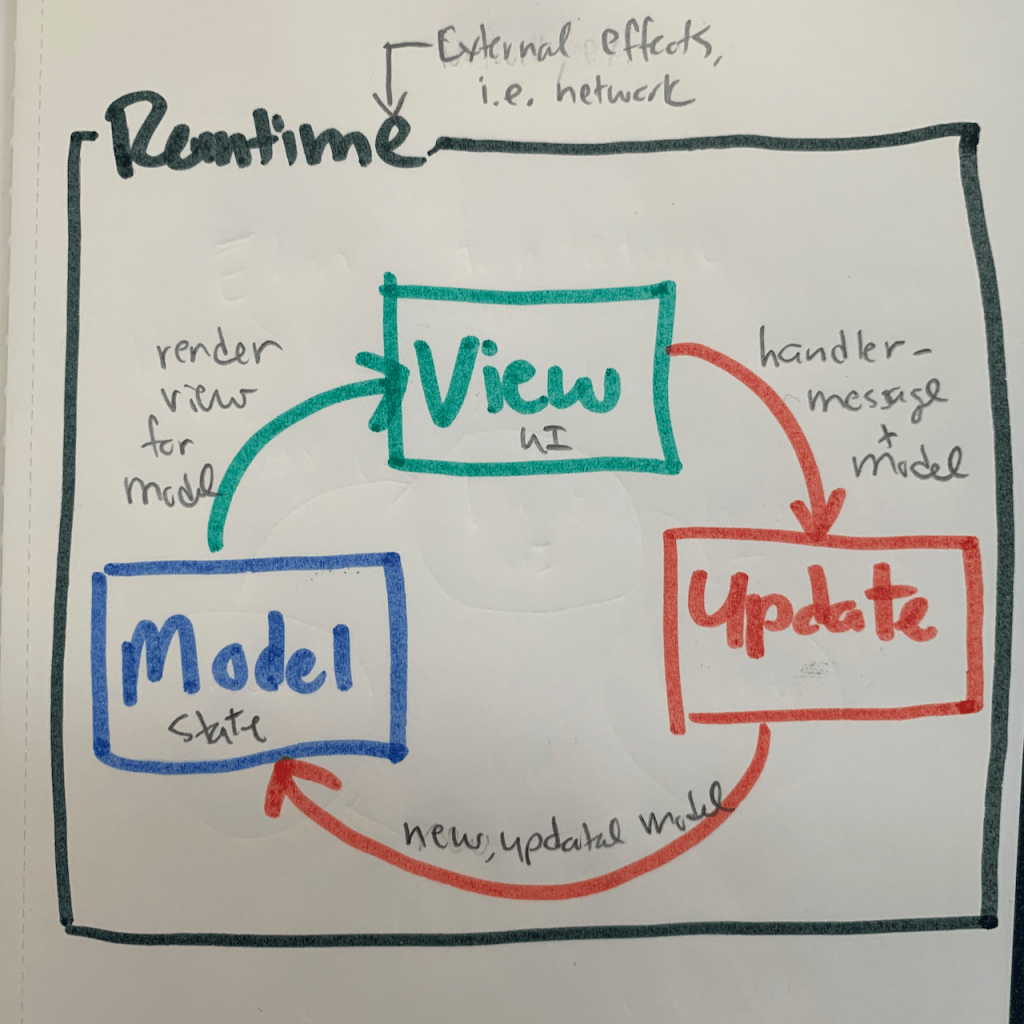
I even made my own diagram just to make sure I “got” it. The devil is in the details, but I think this is right. πŸ€·πŸ»β€β™‚οΈ It definitely seems simpler than VIPER.